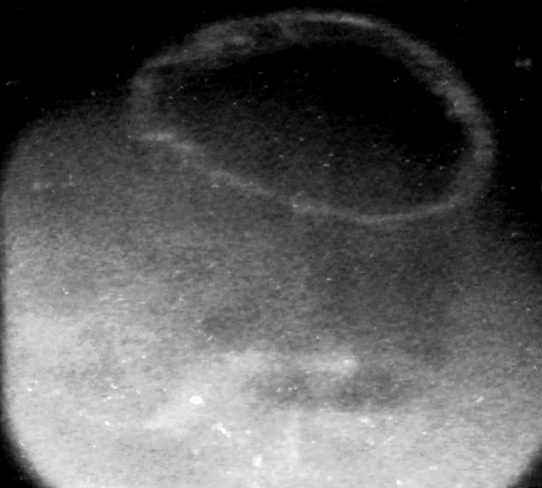
No human has ever seen a complete aurora. The lights make circles around the magnetic poles too vast for any ground viewpoint, visible only as arcs and curtains from inside the phenomenon. This week NASA’s Astronomy Picture of the Day featured the whole thing: a full auroral oval imaged in ultraviolet by the SMILE spacecraft, glowing around the pole in daylight, turbulent across a single hour of late July.
SMILE (the Solar wind Magnetosphere Ionosphere Link Explorer, a joint ESA and Chinese Academy of Sciences mission) exists to watch exactly this boundary: where the solar wind meets Earth’s magnetosphere, the shield that keeps the atmosphere and the power grid on speaking terms. Its ultraviolet imager caught the oval not as a postcard but as a process, a ring of energy input flickering and restructuring minute by minute as the solar wind’s pressure and direction shift. Points of starlight drift at the frame’s edges as the spacecraft orbits; the oval itself breathes.
The science in the picture is the variability. Auroras are the visible receipt for energy dumped into the upper atmosphere from the magnetosphere, and their speed of change tells researchers how that coupling responds in real time. Forecasters of space weather care because the same coupling, overloaded, becomes the geomagnetic storm that heats power lines, degrades GPS, drags satellites and, in the famous worst cases, blacks out provinces. A complete oval, observed continuously, is the difference between forecasting from a keyhole and watching the whole door.
There is also a quiet geopolitical footnote in the pixels: SMILE is European and Chinese instruments sharing one spacecraft and one dataset, at a moment when space cooperation headlines mostly run the other way. The Sun does not care, and neither, apparently, does the magnetosphere. The mission’s goal, stated plainly by its agencies, is to understand the Sun-Earth interaction well enough to protect astronauts, spacecraft and ground grids. Protection begins with seeing the system whole.
Apollo gave humanity the photograph of Earth entire, and it reorganised how the planet thought about itself. SMILE’s oval is a smaller revelation of the same kind: our protective shield has a shape, it has weather, and it can now be watched having both. The lights were always a system. We just finally built the vantage point where the system fits in one frame.