
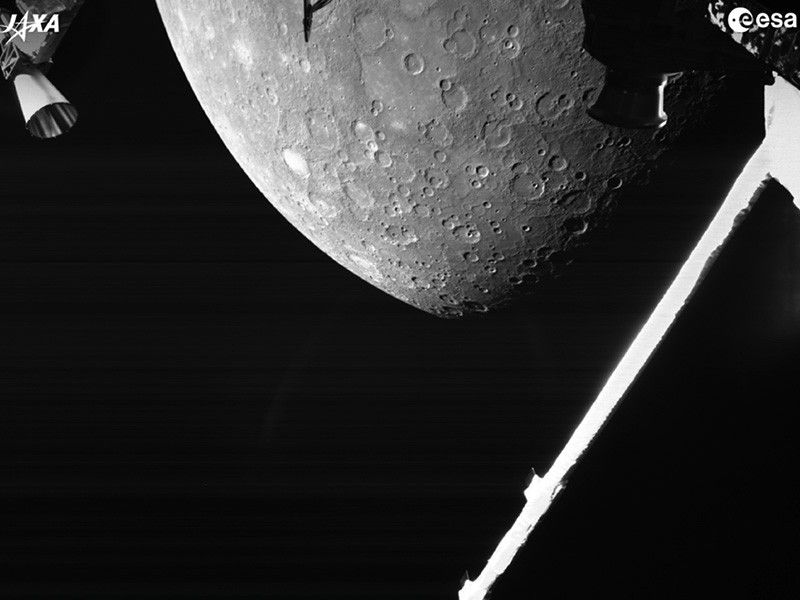
BepiColombo Reaches Mercury Orbit After Eight Year Journey, But A Glitch Cuts Thruster Burn Short
After an eight year journey through space, the European Japanese spacecraft BepiColombo has begun orbiting Mercury, the smallest and innermost planet in the solar system. The European Space Agency confirmed on Saturday, November 21, that the spacecraft had entered orbit, becoming only the second spacecraft in history to achieve the milestone, but the agency also reported a glitch involving the thrusters during the maneuver.
In a social media post on Sunday, November 22, the agency said the spacecraft had a successful entry into orbit, but the thruster burn was shorter than planned following a software issue. The spacecraft is safe, and teams at the European Space Operations Centre in Darmstadt, Germany, are working to understand what happened. The agency said updates would be provided on Monday.
BepiColombo was launched in 2018 and has travelled billions of miles to reach Mercury, a world of extreme heat, extreme cold and a surface scarred by craters. The mission is a composite of two orbiters with different scientific goals: the European Space Agency Mercury Planetary Orbiter and the Japanese Aerospace Exploration Agency Mercury Magnetospheric Orbiter. The two are due to separate on December 9 and 10.
Why Mercury Is So Hard To Reach
Mercury is close to the Sun, which makes it one of the hardest planets to visit. A spacecraft must fight the Sun gravity to slow down enough to enter orbit, rather than simply falling past the planet, and it must survive temperatures that swing by hundreds of degrees between day and night. BepiColombo used a series of flybys of Earth, Venus and Mercury itself to shed speed over eight years before the final insertion burn.
That long approach is why the shortened thruster burn matters, even though the spacecraft is in orbit. Engineers need to know whether the orbit is the one they planned and whether the software fault could affect future maneuvers.
What Comes Next For The Mission
If the orbit checks out, BepiColombo will begin a science campaign that could reshape what we know about the closest planet to the Sun. Its instruments will map the surface, study the thin exosphere, probe the magnetic field and investigate how Mercury formed with such a large iron core. Only NASA MESSENGER has orbited Mercury before, from 2011 to 2015, so BepiColombo will be the first mission to study the planet with two orbiters working together.
For now, the mood at mission control is cautious relief. Eight years of travel ended with a spacecraft in orbit around Mercury, which is a triumph by any measure, but the glitch is a reminder that spaceflight rarely goes exactly to plan.